What is BMR?
Your basal metabolic rate is the energy your body uses at complete rest to keep you alive: breathing, circulating blood, keeping your temperature steady and repairing cells. For most people it makes up 60–70% of all the calories they burn in a day. Movement, exercise and digesting food make up the rest.
The three formulas
Mifflin-St Jeor (1990)
- Men: 10 × kg + 6.25 × cm − 5 × age + 5
- Women: 10 × kg + 6.25 × cm − 5 × age − 161
The most accurate of the three for most adults, and the one dietitians use by default.
Harris-Benedict (revised by Roza and Shizgal, 1984)
- Men: 88.362 + 13.397 × kg + 4.799 × cm − 5.677 × age
- Women: 447.593 + 9.247 × kg + 3.098 × cm − 4.330 × age
The classic formula from 1919, updated in 1984. It tends to give results 5% or so higher than Mifflin-St Jeor.
Katch-McArdle
BMR = 370 + 21.6 × lean body mass (kg). Because it uses lean mass rather than total weight, it's the better choice if you know your body fat percentage, especially if you're very muscular. Don't know yours? Use our body fat calculator.
Worked example
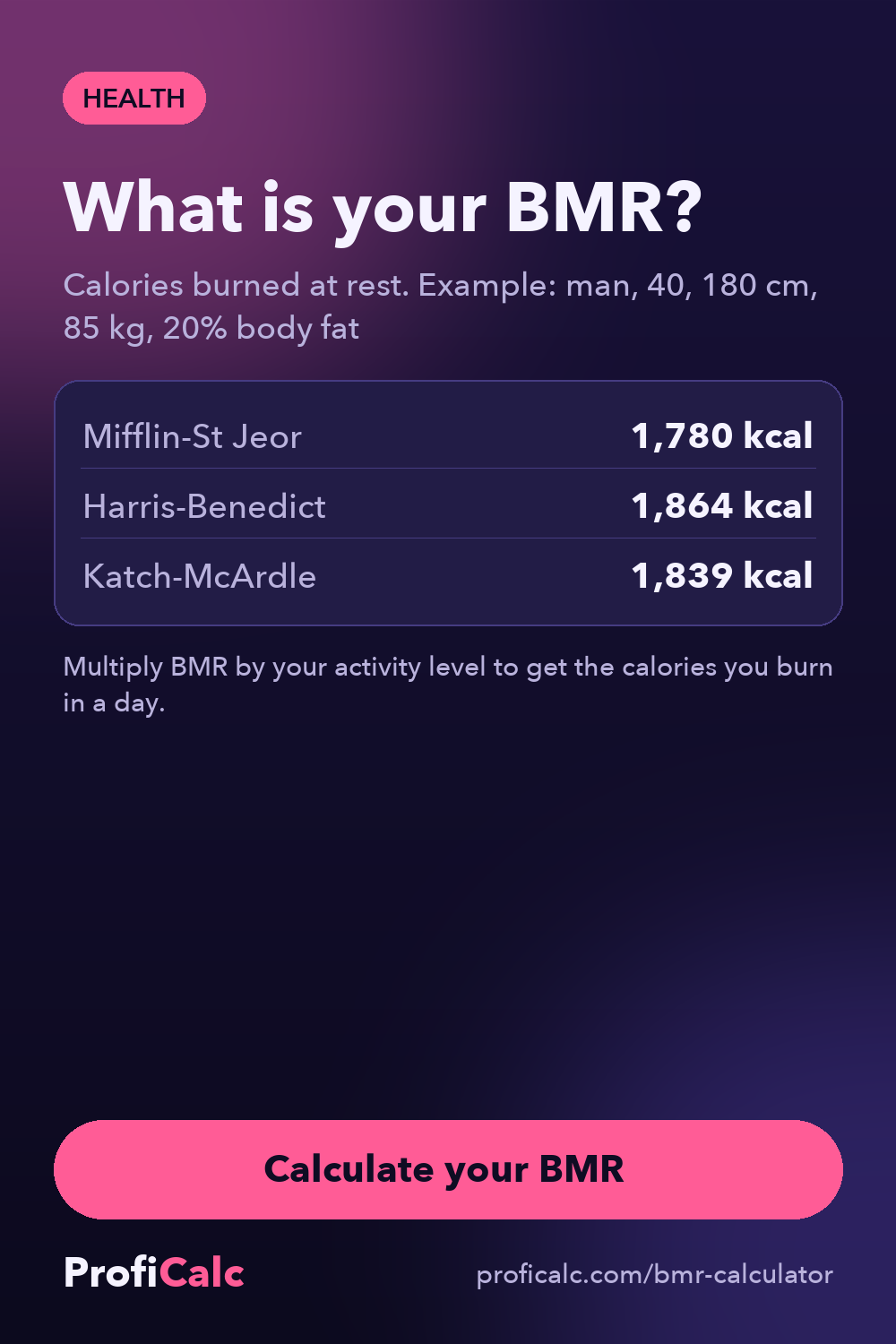
A 40-year-old man, 180 cm and 85 kg, with 20% body fat:
- Mifflin-St Jeor: 850 + 1,125 − 200 + 5 = 1,780 kcal
- Harris-Benedict: 88.4 + 1,138.7 + 863.8 − 227.1 = 1,864 kcal
- Katch-McArdle: lean mass = 85 × 0.8 = 68 kg, so 370 + 21.6 × 68 = 1,839 kcal
From BMR to daily calories
To get the calories you burn in a full day, multiply BMR by your activity level: 1.2 if sedentary, 1.375 for light exercise, 1.55 for moderate, 1.725 for hard exercise and 1.9 for very active. The calorie calculator does this and also gives targets for losing or gaining weight.
What changes your BMR
- Muscle: muscle burns more energy than fat at rest, so strength training raises BMR a little.
- Age: BMR falls slowly with age, largely because people lose muscle.
- Size: bigger bodies burn more, which is why BMR drops as you lose weight.
- Thyroid and hormones: an underactive thyroid can lower BMR noticeably. Talk to a doctor if your weight changes without explanation.
This calculator gives general information only and is not medical advice. Talk to a doctor, midwife or registered dietitian about your own health.
Frequently asked questions
What is a normal BMR?
Many adult women have a BMR of roughly 1,200–1,500 kcal a day and many men 1,500–1,900, depending on size and age.
Is BMR the same as RMR?
Nearly. Resting metabolic rate (RMR) is measured under less strict conditions and usually comes out slightly higher, but the two are often used interchangeably.
Should I eat my BMR to lose weight?
Not usually. BMR is what you burn lying still all day. Eating at BMR is often a bigger deficit than you need. Eat a little below your TDEE instead.
Which BMR formula is most accurate?
For most adults, Mifflin-St Jeor. If you know your body fat percentage, Katch-McArdle can be more accurate, especially for lean or muscular people.
How can I increase my BMR?
Building muscle with strength training raises it slightly. Eating enough protein, sleeping well and not cutting calories too hard also help keep it from dropping.