Day rate vs. hourly rate
Contractors in IT, consulting, film and construction often charge a day rate: a fixed price for a working day, usually 7.5 to 8 hours. It's simpler to invoice, and you don't get paid less for working efficiently.
The monthly figure assumes you work every week of the year. In reality, contractors usually bill 200–230 days a year once holidays and gaps between contracts are counted, so budget with that in mind.
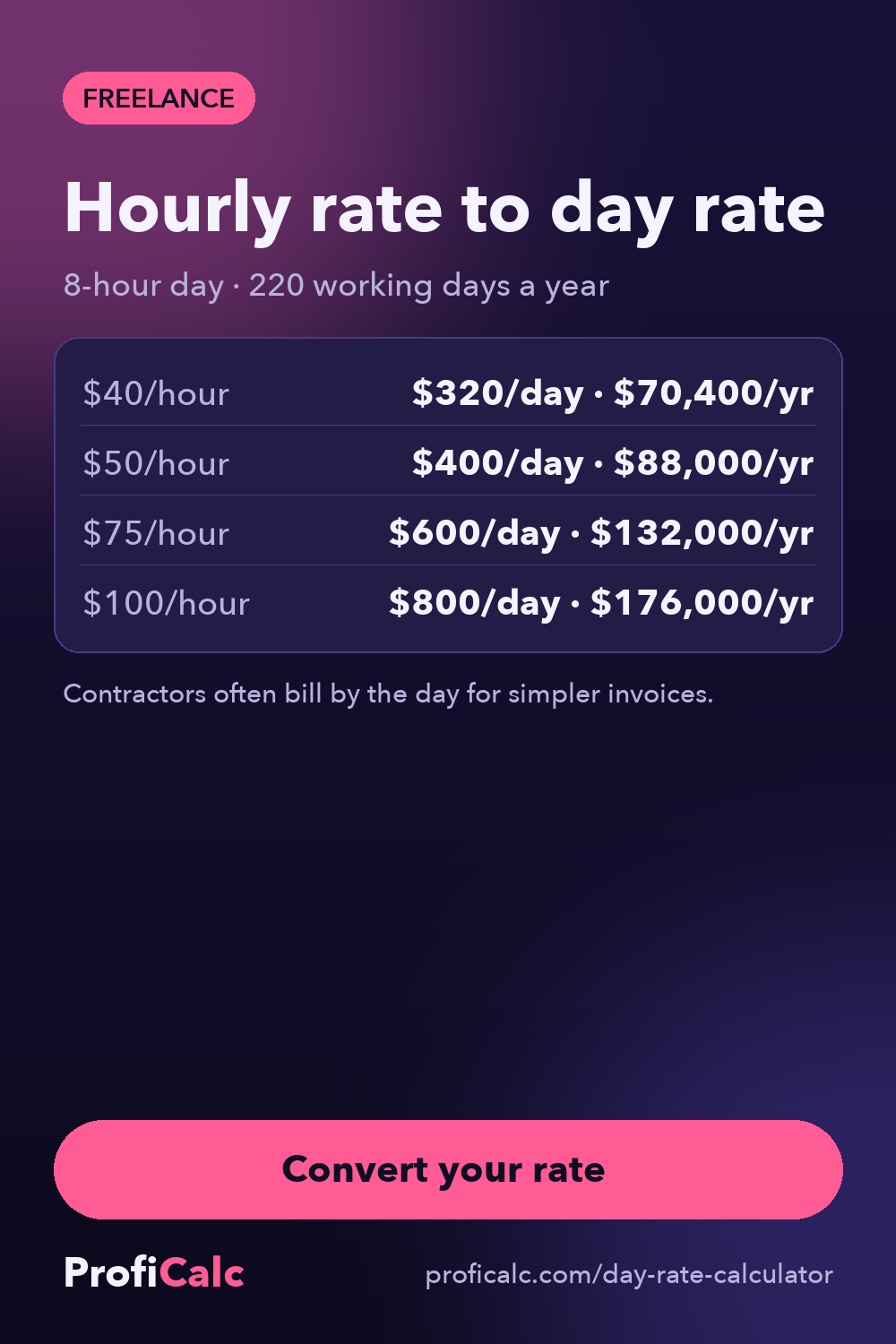
Hourly rate to day rate (8-hour day)
| Hourly | Per day | Per year (220 days) |
|---|---|---|
| 25 | 200 | 44,000 |
| 40 | 320 | 70,400 |
| 50 | 400 | 88,000 |
| 60 | 480 | 105,600 |
| 75 | 600 | 132,000 |
| 100 | 800 | 176,000 |
| 125 | 1,000 | 220,000 |
How to set a day rate from a salary
Divide the salary you'd earn as an employee by about 220 working days, then add 30–50% to cover the holiday pay, pension, equipment and gaps between contracts that an employer would otherwise pay for. A 60,000 salary is about 273 a day as an employee, so roughly 350–410 a day as a contractor. The contractor rate calculator works this out in detail.
Frequently asked questions
How do I convert an hourly rate to a day rate?
Multiply your hourly rate by the hours in your working day. For example, 75 an hour × 8 hours = 600 a day.
How do I convert a day rate to an hourly rate?
Divide the day rate by the hours in your working day. 500 a day over 8 hours is 62.50 an hour, or 66.67 over a 7.5-hour day.
How many hours is a day rate?
Usually 8 hours, though 7.5 hours is common in the UK. Agree it in your contract so overtime is clear.
How many days a year does a contractor work?
Typically 200–230 billable days, after holidays, sick days and time between contracts.