Percentage change formula
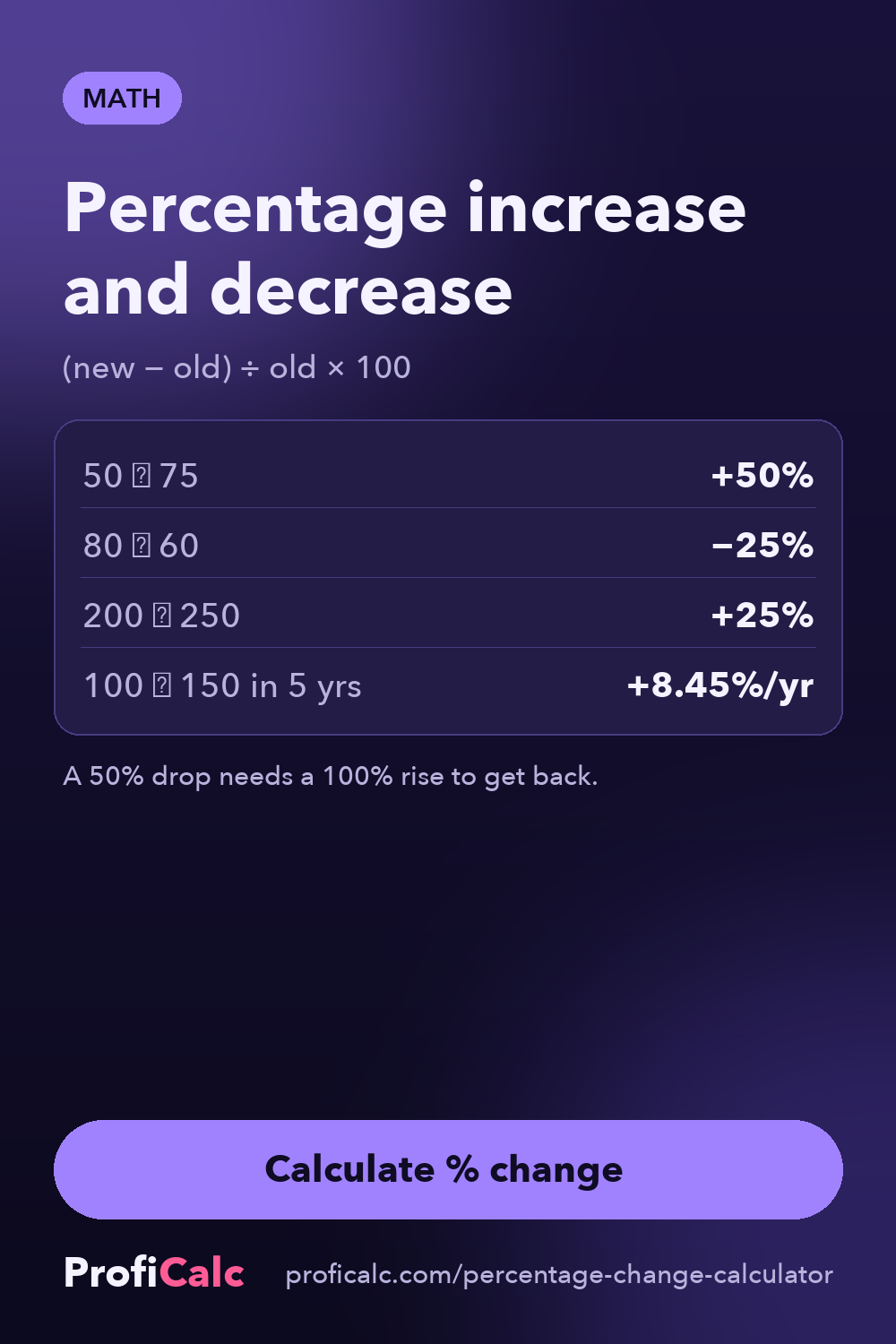
Percentage change = (New value − Original value) ÷ Original value × 100. A positive result is an increase and a negative result is a decrease.
Why a 50% drop needs a 100% rise to recover
Percentage changes aren't symmetrical. If 100 drops 50% to 50, it needs to rise 100% to get back to 100. Keep this in mind when comparing price changes, investment returns or sales figures.
Percentage change vs. percentage points
If an interest rate goes from 4% to 5%, that's a rise of 1 percentage point but a 25% percentage increase. News reports often mix the two up.
Examples
- From 250 to 300: (300 − 250) ÷ 250 × 100 = +20%
- From 80 to 60: (60 − 80) ÷ 80 × 100 = −25%
- A salary from 45,000 to 48,600: +8%
- A price from 19.99 to 24.99: +25.01%
Annual percentage increase over several years
If something grew from 100 to 150 over 5 years, the total increase is 50%, but the average annual increase is about 8.45%, not 10%, because each year builds on the last. Use the CAGR calculator to work out the yearly rate.
Frequently asked questions
How do I calculate percentage increase?
Subtract the old value from the new one, divide by the old value, and multiply by 100.
How do I calculate percentage decrease?
Subtract the new value from the old one, divide by the old value, and multiply by 100. From 80 to 60 is a 25% decrease.
How do I calculate annual percentage increase?
For one year, use the percentage change formula. Over several years, use (end ÷ start)^(1 ÷ years) − 1 to get the average yearly rate.
How do I decrease a number by a percentage?
Multiply it by (1 − percentage ÷ 100). To reduce 80 by 25%, calculate 80 × 0.75 = 60.