What is the break-even point?
Your break-even point is the number of sales at which revenue exactly covers all your costs. Below it you're losing money, and above it you're making a profit.
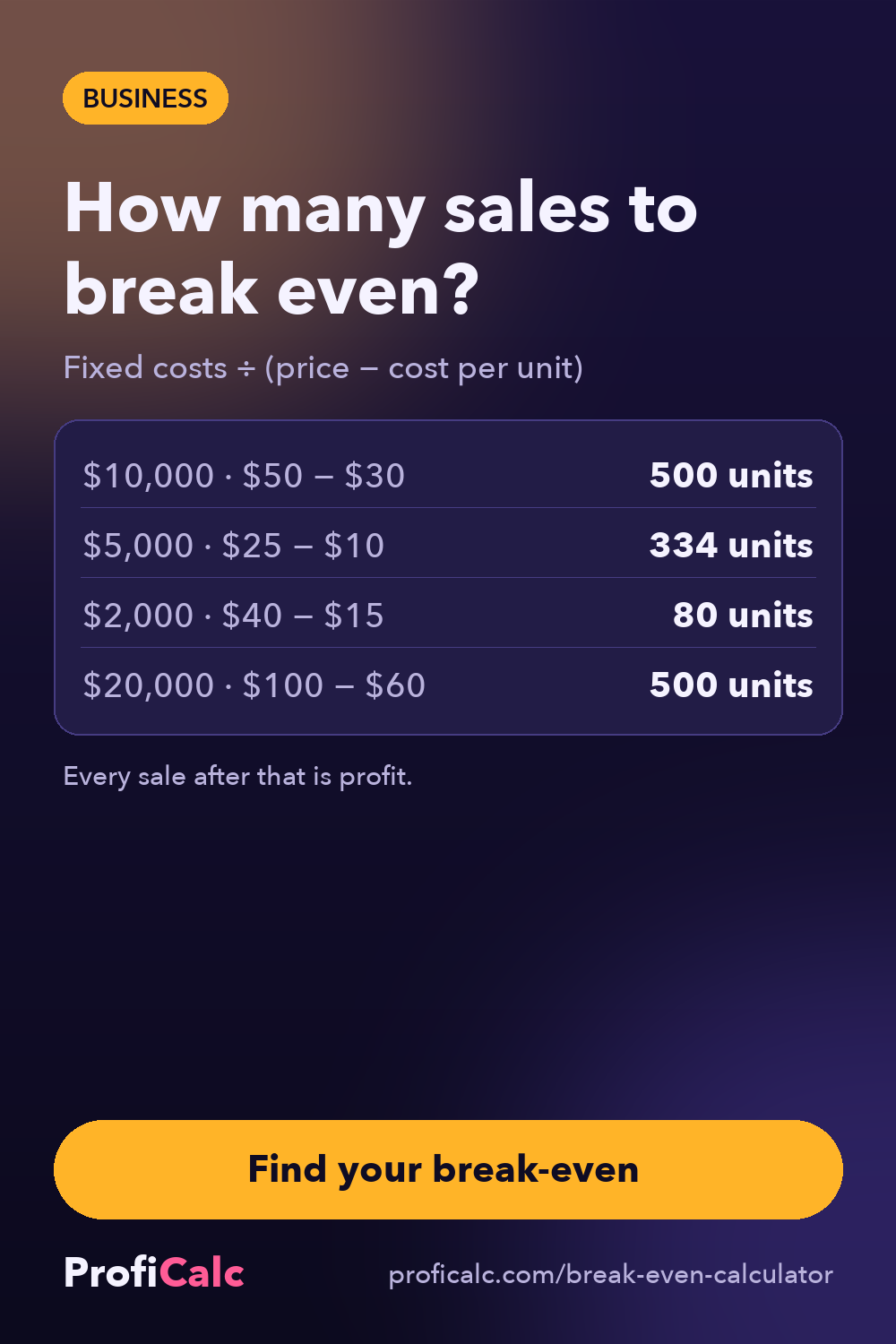
Formula: Break-even units = Fixed costs ÷ (Price − Variable cost per unit)
The figure in brackets is called the contribution margin: how much each sale contributes towards paying your fixed costs.
How to lower your break-even point
- Raise your price, even slightly
- Cut variable costs, for example by negotiating with suppliers or reducing shipping costs
- Reduce fixed overheads
Worked example
A small candle business has fixed costs of $3,000 a month (rent, software, insurance). Each candle sells for $25 and costs $10 to make and ship, so every sale contributes $15 towards fixed costs. Break-even = $3,000 ÷ $15 = 200 candles a month, or $5,000 in sales. Sell 300 and the extra 100 candles bring $1,500 of profit.
Margin of safety
The margin of safety shows how far sales can fall before you make a loss: (actual sales − break-even sales) ÷ actual sales. At 300 candles, (300 − 200) ÷ 300 = 33%. Sales could drop by a third and you'd still cover your costs. A thin margin of safety is a warning to cut fixed costs or raise prices.
Frequently asked questions
What are fixed and variable costs?
Fixed costs stay the same however much you sell, like rent and subscriptions. Variable costs grow with each sale, like materials, packaging and payment fees.
How do I calculate break-even revenue?
Multiply the break-even units by your price per unit.